What is Gerrymandering – and How it Affects Voters

Political and racial gerrymandering are hot topics in the news today, and vitally important for anyone who cares about the power of their vote to understand.
Gerrymandering is when electoral district boundaries are drawn to favor one political party over another.
You’ve probably heard about the redistricting battle between Texas and California – which involves both political and racial gerrymandering. During its 2025 legislative session, the Texas legislature decided to redraw its congressional maps to explicitly favor Republican seats — an effort to maintain control of Congress in the 2026 midterm elections. The new maps are projected to give the party five additional seats in the House of Representatives — a clear act of political or partisan gerrymandering. In doing so, the Texas legislature shifted the boundaries of electoral districts to favor the GOP and weakened the voting power of Black and Latino Texans — also known as racial gerrymandering, the deliberate drawing of electoral district boundaries to unfairly and intentionally weaken the voting power of people based on their race.
In response, the California legislature countered that action by passing a ballot measure to adopt a new congressional map that favors Democrats. The measure offsets the additional GOP seats gained in Texas by creating additional Democratic seats in the House of Representatives. Many other states on both sides are pursuing similar actions in an unprecedented challenge to the very pillars of our democracy.
One of the key outcomes of gerrymandering is that it distorts the fair representation of voters in a state by limiting their influence in state legislatures or Congress. As the battle around gerrymandering heats up, many are raising questions about the future of voting rights and fair representation in this country.
The practice has long undermined fair representation in our home state of Alabama, especially for Black communities – particularly given that we make up almost a third of the population.
For instance in 2021, the state legislature drew maps that “packed” unnecessarily large numbers of Black voters into one state senate district in the Montgomery area. While this allowed Black voters to decisively elect their preferred candidate in that district, it reduced their presence in neighboring districts and therefore, weakened their ability to elect representatives who would reflect their interests.
Alabama lawmakers also “cracked” or split significant numbers of Black communities in the Huntsville area across multiple districts, spreading Black voters thinly across state senate districts, diluting their voting power again.
Black voters make up almost a third of Alabama’s population, and should have the chance to affect the outcome of state senate races. But because of the partisan gerrymandering, they only had the opportunity to elect one senator out of 35.
It’s important to note that gerrymandering impacts more than just politics. It directly affects economics. When communities lose fair representation, they lose voices in government to fight for their needs. In Alabama, this has allowed gerrymandering to widen racial inequities generation after generation. Black communities in the state have had less access to resources, economic investment and public services such as schools, hospitals, transit or housing.
Selma is a painful example. The majority-Black city frequently receives less state support for economic development, poverty relief, and community health than their needs demand. This compounds Selma’s political, economic, and social struggles — preventing sustainable progress, perpetuating harmful practices and reinforcing neglect.
In 2023, the Supreme Court ruled against the Alabama legislature in Allen v. Milligan, saying its 2021 map violated the Voting Rights Act of 1965 and ordered lawmakers to draw new maps with at least two districts where Black voters had a fair chance to elect their candidate of choice. But – that decision and the resulting redrawn maps in our state are now in jeopardy with the Supreme Court’s recent hearing of the Louisiana case Callais v. Landry. In this case, the Louisiana state legislature drew a new congressional map in 2024 to comply with a court order that found that the previous map weakened Black voters’ influence under the Voting Rights Act. White voters sued the state soon thereafter, arguing that the state committed racial gerrymandering when it created the new map. The Court is expected to rule in the case by June 2026.
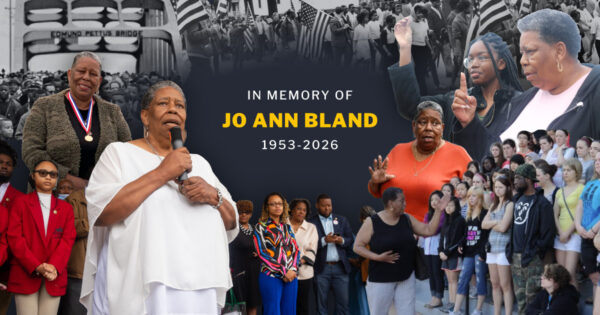
In 1965, foot soldiers in Selma, like our founder Ms. Jo Ann Bland, risked their lives for Black people to have a voice in what happens in their communities and to be fairly represented at all levels of government — after nearly a century of having no voice or representation.
At Foot Soldiers Park, we believe that protecting that legacy is central to ensuring every generation knows its power in shaping democracy – by fighting for the right to vote, demanding fair representation, and building communities where every voice truly counts.
Sign up and stay connected!
Sign up today and stay up to date on the latest news from our team and how you can get involved.