

Why Selma’s Future Matters to Democracy Everywhere
In the Crossroads of Civil Rights and Economic Justice
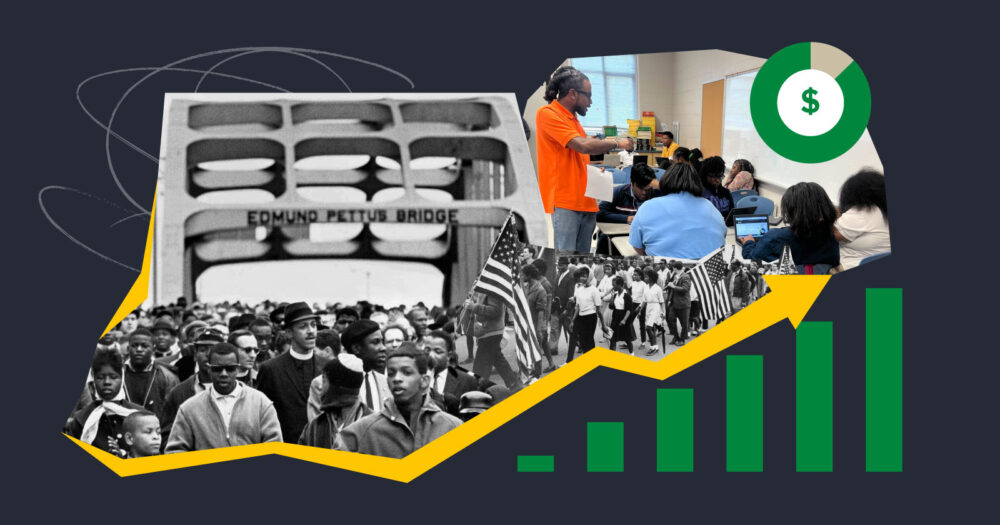
Selma, Alabama—the birthplace of the Voting Rights Act—has taught America a vital truth: civil rights without economic power perpetuates oppression. Sixty years after Bloody Sunday, the brave foot soldiers who crossed the Edmund Pettus Bridge won the right to vote for everyone in America, but economic justice has remained out of reach for most Black residents in Selma. Today, Foot Soldiers Park is leading a transformational movement at the intersection of two critical areas for democracy: building wealth and breaking generational cycles of poverty, and civic education as a means to civil rights in action. These focus areas recognize what the foot soldiers of 1965 knew well—true liberation requires both political and economic power.
The Harsh Reality: Selma’s Economic Crisis Since 1965
Despite winning voting rights, Selma’s Black community continues to face devastating economic challenges that echo the deprivation of the Jim Crow era. The statistics paint a sobering picture: over 80% of Selma’s population is Black and 41% of residents live under the poverty line. The median household income in Selma is below the state average at just $32,184 but for Black residents this number is even lower at the astonishing $27,755. In 1965, according to a Civil Rights Commission report, only 130 of 15,115 eligible Black residents in Dallas County were registered to vote—less than 1%.
However, while voting rights were won, economic opportunity was not. By 2015, fifty years after Bloody Sunday, unemployment for young Black residents in Selma exceeded 20%, and many families still lived in the same government-subsidized housing they occupied in 1965. The closure of Craig Air Force Base in 1977, which had provided $35 million in payroll, triggered an economic collapse from which Selma has never recovered. Manufacturing jobs disappeared, Black-owned businesses shuttered, and white flight accelerated, leaving behind the city’s Black community trapped in generational poverty.
The wealth gap tells an even starker story. In Dallas County, where Selma is located, 43% of residents have subprime credit scores below 660, severely limiting access to homeownership and capital. The Black homeownership rate nationally is just 44%—30 percentage points below White homeownership (74%). In the Black Belt region where Selma sits, median home values are 35% lower than the rest of Alabama, automatically putting residents at a long-term disadvantage to accumulate wealth and build stable homes. For every dollar earned by White households in Alabama, Black households earn just 58 cents.
Building Generational Wealth Through the Power of Civic Engagement
Foot Soldiers Park’s Building Wealth programs address this crisis head-on through financial literacy workshops, entrepreneurship training, homeownership preparation, access to resources and workforce development. Our newly launched BUILD UP pilot at Selma High School is designed to equip students with budgeting skills, career planning, and business fundamentals—creating strong foundations and sustainable pathways out of poverty. These programs recognize that economic barriers perpetuate racial injustice and that wealth-building and economic mobility is essential to full citizenship.
Simultaneously, through the programs of our Civil Rights in Action impact area we work to preserve Selma’s sacred history by educating and empowering the next generation civic leaders and residents to continue the fight. Through our Footsteps and Build Up programs, young people can learn first hand that activism is not just part of history—it’s their inheritance, inspiration and responsibility. These immersive programs ensure that Selma’s legacy informs contemporary movements for justice, teaching that the fight for freedom is not an end point, but an act of sacrifice and bold efforts.
In Selma, the struggles for civic duty, civil rights, and economic justice are inseparable. The right to vote and to be heard in public life directly shapes whether communities gain the investments and protections needed to prosper and gain economic vitality. When Black residents are underrepresented in government and decision-making spaces, policies often ignore or even reinforce the realities of low wages, food insecurity, limited homeownership, and barriers to business ownership that define daily life for many families. Civic engagement programs like our Community Engagement Corps, Footprints, and voter education efforts help people understand how school funding, housing policy, access to capital, and workforce programs are all outcomes of what and whom they vote for.
At the same time, wealth-building initiatives that expand financial literacy, support Black entrepreneurship, close skills gaps, and connect residents to homeownership and employment opportunities give people the material stability and confidence to participate fully in democracy and advocate for their interests. Breaking the cycle of poverty in places like Selma requires community engagement, participation and sustainable investment in both the civics and economic fabric of the town: without political power, economic gains are fragile and easily reversed, and without economic security, residents are left vulnerable to exclusion from the very processes that determine their futures generation after generation.
Why This Work Matters Beyond Selma
The 1965 Selma-to-Montgomery marches exposed suppression of Black political power and helped win the Voting Rights Act, proving that federal policy change and local organizing are inseparable when confronting racial injustice.
When people in Selma face an economic crisis of this scale today, economic justice and democracy everywhere are at risk. The same forces that once denied Black Americans the vote now deploy economic inequality, voter suppression laws and disinvestment to diminish the political power of Black communities and silence their voices. If the city that birthed voting rights cannot provide its residents with basic economic opportunities, then the victories of 1965 remain hollow promises.
At Foot Soldiers Park we understand that economic empowerment and civic engagement are co-dependent and inseparable—you cannot have one without the other. By investing in the future of Selma’s community, we invest in the future of democracy itself, proving that every community deserves both a political voice and the resources to thrive.
Sign up and stay connected!
Sign up today and stay up to date on the latest news from our team and how you can get involved.